
Your Straw Questions, Answered.
The questions people ask us most, answered plainly. Including what it can’t do.


 0.01 micronFiner than bacteria and parasites
 1,800 gallonsThrough every straw
 No power neededNo pump, no stove, no batteries
What It Filters Out
- ✓BacteriaE. coli, salmonella, cholera
- ✓ProtozoaGiardia, cryptosporidium
- ✓Dirt and sediment
- ✓Chlorine, bad taste and odour
What It Doesn’t
- ✕Viruses
- ✕Salt and sea water
- ✕Heavy metalsLead, mercury
- ✕Fuel, oil and industrial chemicals
- ✕Radiation
- ✕Fluoride or nitrates
Made for fresh water that’s dirty, not poisoned.
What It Filters
What does the Blackout Water straw filter out?
It removes 99.9999% of bacteria (including E. coli, salmonella and cholera) and 99.9% of protozoa (including giardia and cryptosporidium). It also removes dirt and sediment, and the carbon stage cuts chlorine, bad taste and odour.
It’s made for fresh water that’s dirty but not poisoned: creeks, rain barrels, floodwater after a storm, and tap water during a boil notice.
What does it NOT filter out?
We’d rather you hear this from us than find out the hard way. The straw is not rated to remove:
- Viruses
- Salt (it won’t make sea water drinkable)
- Heavy metals such as lead or mercury
- Fuel, oil or industrial chemicals
- Radiation or nuclear fallout
- Fluoride or nitrates
If you think water is contaminated with any of these, don’t drink it, even through a filter.
Does it remove viruses?
No, it isn’t rated for viruses. Most viruses in water come from sewage.
If you’re drinking floodwater or anything near sewage, filter it with the straw first, then boil it for one minute or use a purification tablet. Filtering first takes out the dirt and bacteria, so the boiling or tablet works properly.
Can I drink sea water through it?
No. No straw filter removes salt. Turning sea water into drinking water needs a desalination system. The straw is for fresh water only.
Which water sources can I use it with?
✓Yes
- Rivers, creeks, lakes and ponds
- Rain barrels and water butts
- Tap water during a boil notice
- Melted snow
!Filter, then boil
- Floodwater: filter it, then boil or use a tablet (viruses)
✕No
- Swimming pool water: pool chemicals and salt systems aren’t filtered out
- Sea water
- Water near fuel spills, farm run-off or industrial sites
Why not just boil water?
Boiling kills germs, but it needs fuel, a pot, a fire or stove, and time. In a power cut or storm, you may have none of those. Boiling also leaves the dirt in.
The straw needs nothing but water. Best plan: the straw for everyday emergency drinking, plus boiling when viruses are a risk.
What does 0.01 micron mean?
A micron is one thousandth of a millimetre. Our membrane’s pores are 0.01 micron, 20 times finer than the standard 0.2 micron trail straw. Bacteria and parasites are far too big to fit through.
Using It
How do I use it?
Three ways:

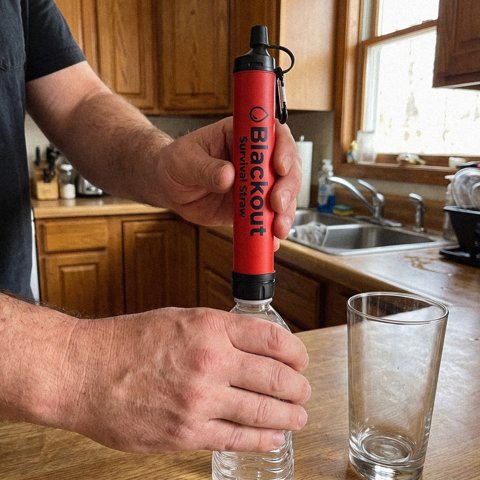
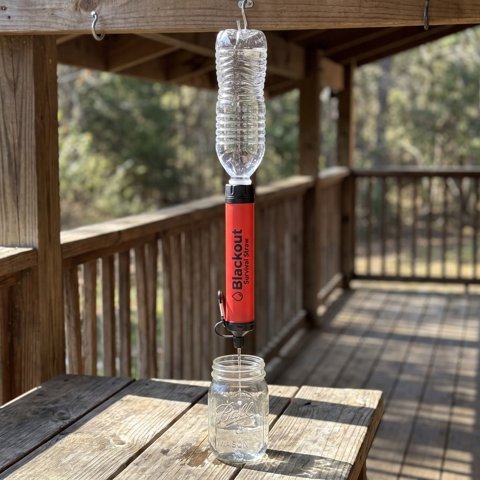
What comes in the box?
- The straw
- 1 litre squeeze pouch
- Backflush syringe
- Clear tube
- Lanyard
- Carabiner
See what each one is for on our How to Use page.
Is it hard to suck water through?
It takes a little more effort than a normal straw, because the filter is so fine. That’s the trade-off for 0.01 micron protection.
The first few sips are the hardest while the membrane wets. If it gets harder over time, backflush it and it draws easily again.
Can kids and older adults use it?
Yes, anyone can use it, at any age. It’s just a straw.
Cleaning, Lifespan & Storage

The 30-Second Backflush
Use the syringe in the box. Do it after each use, or any time it gets hard to draw water.
How do I clean it?
Backflush it with the syringe in the box. Fill the syringe with clean or already-filtered water, then push it back through the straw the opposite way to how you drink. That flushes the trapped dirt and bacteria back out.
Do it after each use, or any time it gets hard to draw water.
I’m in an emergency with no clean water. How do I backflush it?
Use water you’ve already filtered through the straw. Sip some into a clean cup or bottle first, then use that to backflush.
Where does all the dirt and bacteria go?
It stays on the outside of the membrane, the dirty side. It can’t pass through to your mouth. Backflushing pushes it back out the way it came in, which is why the straw keeps working.
How long does it last?
One straw filters up to 1,800 gallons (about 6,800 litres). At a gallon a day, that’s almost five years of drinking water for one person.
How long can it sit on the shelf unused?
10+ years, unused and sealed.
Shelf life and filter capacity are two different things. Shelf life is how long it keeps in storage. The 1,800 gallons is how much water it filters once you start using it.
What if it clogs?
Backflush it. A clogged straw isn’t a dead straw: push water back through with the syringe and it’s ready to use again, until it reaches its 1,800 gallons.
Can I use it once, then put it away for later?
Yes. After use, backflush it, shake it out, let it dry completely (a day or two in the air), then cap both ends and store it somewhere cool and dry.
What about freezing?
A new, dry straw is fine if it freezes, so it’s safe in a car or garage kit. Once it’s been used, keep it from freezing until it’s fully dry. Water left inside can expand and damage the membrane.

Do you sell replacement filters?
There’s no cartridge to replace. The whole straw is the filter, good for 1,800 gallons.
No questions match that. Try another word, like “clean” or “virus”.
One Straw Per Person. That’s the Plan.
Keep one in the kitchen drawer, the car and the emergency kit, so clean water is never more than an arm’s reach away.
See the Survival Straw →